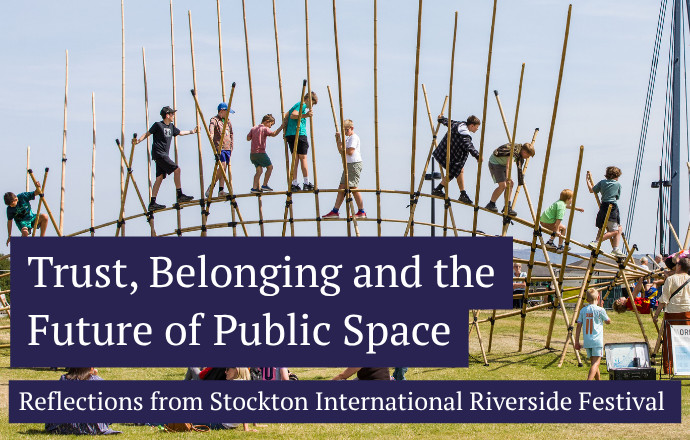
As public space becomes increasingly contested, the role of outdoor arts has never been more important. OutdoorArtsUK (OAUK) continued its long standing collaboration with XTRAX to deliver on the Saturday morning panel discussion that has become a regular feature as part of the Professional Programme at Stockton International Riverside Festival (SIRF) 2026.
The panel was chaired by Dr Beatriz Garcia, academic and chair of Walk the Plank (OAUK member), and was made up of our Director Sho Shibata, Kate Wood from Activate Performing Arts (OAUK member) and Olivier Lataste from Le Cratère Scène nationale d’Alès.
Here is our reflection on a panel discussion that ranged from reflections on culture, identity, belonging and democracy in public spaces.
Why Public Space Matters More Than Ever
Dr Beatriz Garcia set the tone for the discussion, framing public space as one of the most important arenas for social interaction in contemporary society. At a time marked by political polarisation, climate challenges, digital isolation and increasing social fragmentation, public spaces remain among the few places where strangers encounter one another directly.
She raised the question: How can outdoor arts create spaces where people feel they belong while also allowing difference, disagreement and challenge to coexist?
This question sits at the heart of outdoor arts’ value. Unlike many cultural experiences that require tickets, specific knowledge or financial means, outdoor work takes place where people already are, creating opportunities for participation that are open, visible and accessible.
A Collective Vision for Outdoor Arts – Revisiting the Sector Strategy
Each speaker presented their perspective relating to the themes. First up was Sho, who began by reiterating the key message of the Outdoor Arts Strategy for Joy and Belonging:
“Culture belongs to everyone, and public space is where that becomes real”
Citing the strategy, he argued that outdoor arts is uniquely positioned to:
- Remove social, financial and cultural barriers.
- Transform public space into shared civic space.
- Create joy, trust and belonging.
- Support pride in place and regeneration.
- Reach communities historically underserved by arts and culture.
Importantly, the strategy rejects that artistic excellence and accessibility are opposing goals. Instead, the outdoor arts sector sees the two as inseparable. Great art in public space succeeds precisely because it is ambitious, relevant and accessible at the same time.

After reflecting on the strategy, Sho focused on:
“Joy is not frivolous. It’s a civic force.”
In a world often focused on crisis, conflict and economic return on arts, outdoor arts demonstrates that shared moments of joy can strengthen social bonds, build trust and improve community wellbeing whilst providing excellent experiences for audiences.
Circling back to the key themes of the session, he concluded that belonging is not a luxury or an optional extra. It is fundamental to healthy communities and outdoor arts offers a powerful mechanism for creating those feelings because it brings people together in shared experiences that are visible, collective and immediate.
Beyond the Street: Reimagining Access to Landscapes
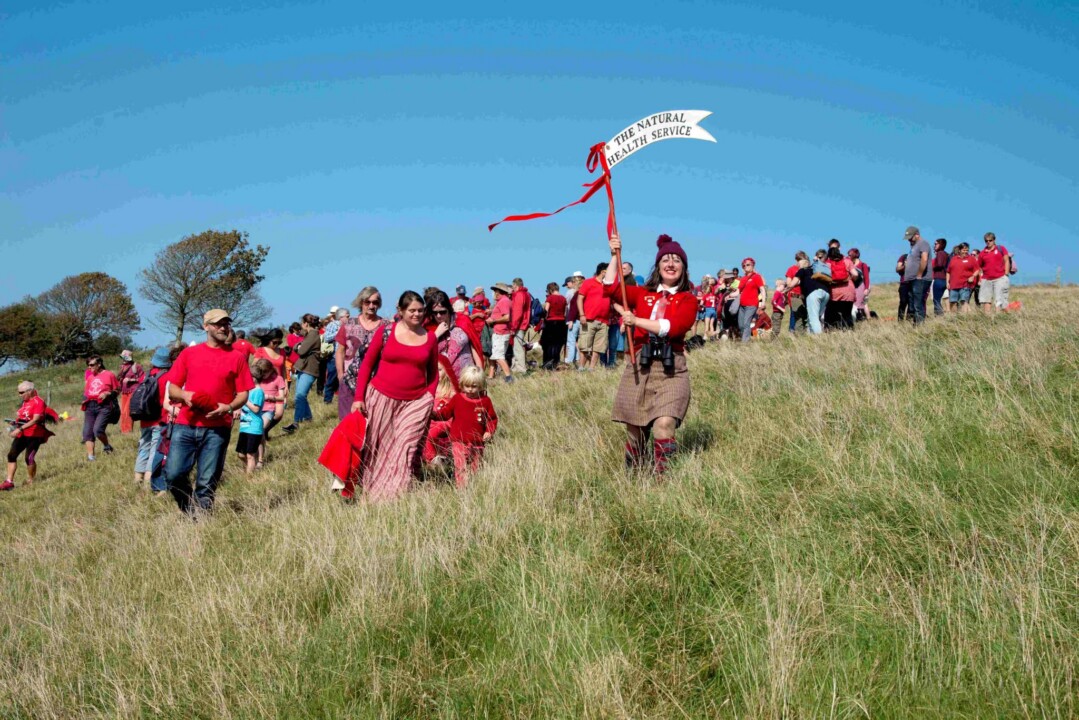
Next, Kate Wood shared her response highlighting that, whilst discussions about outdoor arts often focus on city streets and squares, Activate Performing Arts’ focus is on landscapes: how outdoor arts can open access to and encourage belonging in rural spaces.
Activate’s work with National Landscapes Association (NLA) began after a study by NLA revealed that many people feel excluded from these environments. That despite the impact on wellbeing and connection to nature, many barriers, often not just physical but cultural and psychological, existed that stop people from accessing rural spaces and landscapes.
To address this, Activate and the NLA established a programme of work called “Nature Calling”, which involved commissioning and presenting work that brought together artists and local communities with a focus on engagement with underrepresented groups. The result was not simply greater participation but a deeper sense of ownership, connection and belonging among people who had previously felt these places were not for them.
Trust as the Foundation of Artistic Freedom
Olivier Lataste, Director of Cratère Surfaces in France, gave the final reflectoin where he argued that artistic freedom in public space depends fundamentally on trust.
Trust between:
- Artists and audiences.
- Cultural organisations and local authorities.
- Politicians and cultural institutions.
- Citizens and one another.
While regulations, security planning and risk assessments are necessary, Olivier suggested that excessive control can gradually shrink the space available for experimentation and creative challenge.
In fact, this was reflected in a number of performances across the weekend where we felt that they could only be presented in a festival context with deep trust between local authorities, culture institutions and the artists involved. Something Stockton, alongside other festivals in the UK, is an excellent example of.
He warned of a growing tendency toward self-censorship, where artists and organisations begin filtering ideas before anyone explicitly tells them not to proceed. This creates a culture where risk is avoided, conversations become less challenging and public space becomes less democratic. But Olivier stressed that we must protect artistic freedom because to do this “is protecting society’s capacity to imagine itself together and contribute to building a better democracy”. This means presenting provocative work in public, even in the face of creating risk as a programmer and event organiser.
He concluded with the following message:
“Public space is THE place where the level of democracy can be measured. Street arts are one of the ways democracy experiences itself. Are we still willing to be challenged by art?”
Trust, Risk and Democratic Space
At this point, Dr Beatriz opened up to the floor for their reflections. The SIRF professional programme, with the dedicated work of XTRAX, has become increasingly appealing to programmers and event curators across the globe. So we were able to hear several perspectives from unique national and political contexts. Yet many of our audience who shared reflections came back to similar points around their public spaces being increasingly shaped by questions of safety and security, alongside many spaces that were thought of as public being privately owned and therefore more heavily regulated.
Public space is never entirely neutral. Even where spaces are technically open to all, access is often influenced by cultural expectations, political realities and assumptions about who belongs. What appears to be a shared civic space can feel very different depending on who you are and the context in which you are trying to gather, perform or be represented.
But herein lies the essential challenge, as public space becomes harder to hold as a genuinely democratic space and public debate becomes more polarised and social tensions become more visible, maintaining spaces where people can encounter different perspectives, assemble freely and experience culture together is becoming both more challenging and more important.
This was the heart of the discussion. At a time when it is most precarious and most necessary, outdoor arts bring people into spaces they don’t feel are for them and give them a genuine sense of belonging. Our sector measures the level of democracy itself in public space. It strengthens social bonds, builds trust and improves community wellbeing through joy.
Image credits:
- Morphosis by Cie Moso at Stockton International Riverside Festival 2026, photo: Stockton Council
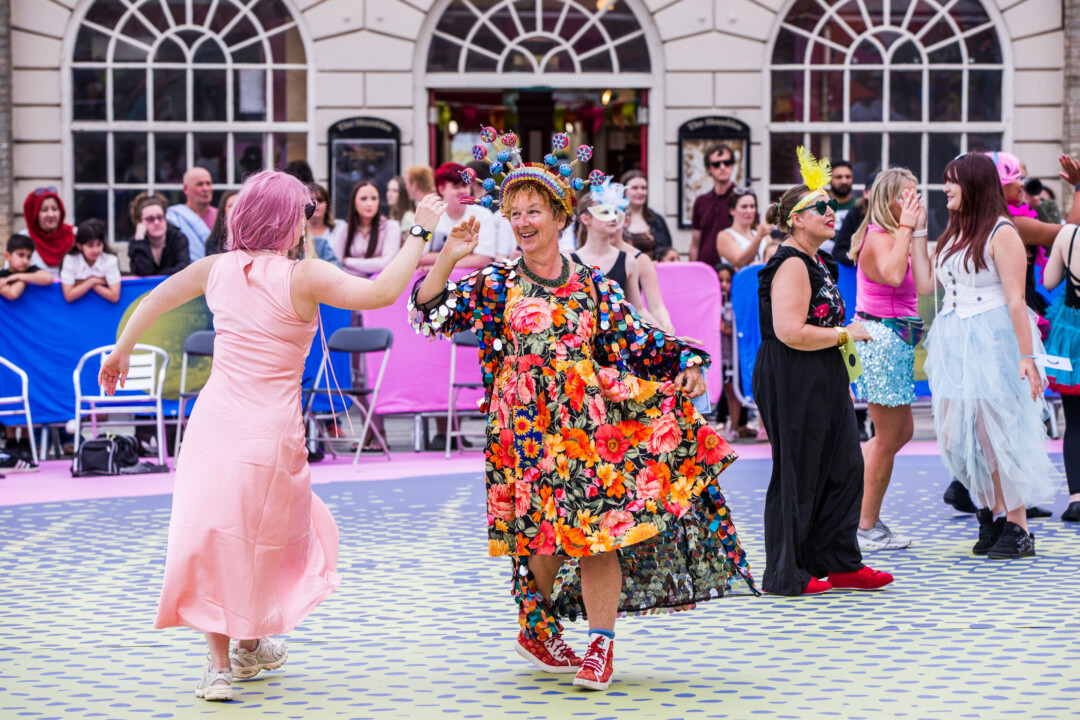
- The Ostentatious Ball by Zoielogic at Stockton International Riverside Festival 2026, photo: Stockton Council
- Lorna Rees leading the AONB 60th Anniversary celebrations, photo: Dorset National Landscape