For the second time running, OutdoorArtsUK General Manager David Doust hosted the Climate Café as part of the Out There Festival Professional Programme in Great Yarmouth. This year, he was accompanied by two speakers: climate activist Ed Gillespie and Artistic Director & Joint CEO of Akademi Dance Subathra Subramaniam.
Ed Gillespie on the Climate Crisis
Ed started the conversation by reflecting on the current status and severity of the climate crisis, highlighting the fragility of our food chain supplies and our reliance on fossil fuels which are often tied to tense geopolitical situations, and how the media reports on the realities of climate change, often showing images of people in the sun with ice creams instead of reporting on the increased number of heat-related deaths.
He explained why we’re in trouble and introduced us to the Jevons Paradox, how the more we innovate and make systems more efficient, the more we increase our overall consumption. He outlined what we’re up against, billionaires funding divisive politics that are encouraging the rollback of hard-fought environmental gains in policy and law.
Yet despite this, there’s hope. He shared that individual behaviour changes, such as taking The Jump, could deliver 27% of the necessary emissions cuts by 2030, and how bold, courageous and moral leadership could change our existing systems.
He closed by noting that, in these times where direct action is increasingly restricted, arts, culture, and storytelling will need to play a much bigger role in influencing behaviours and making climate issues tangible and relatable.
Suba Subramaniam on Using Art to make Climate Change Tangible
Following on from Ed’s thread, Suba Subramaniam explained her background as a trained science teacher and how her artistic practice has always worked at the confluence of art and science.
Suba took us on a journey of her practice, starting with her first trip to the Arctic with Cape Farewell, an organisation that takes artists and scientists to areas directly impacted by the climate crisis.
She said that, as an artist, her role was to ‘metabolise scientific knowledge’: to transform the data into something felt in the body, to create visceral understanding, not just intellectual awareness. As a choreographer, she noted how scientific language and the impact of the climate crisis at times overlapped with the language of movement, for example shifts and migration.
As Artistic Director of Akademi, movement became the focus of their 2023 outdoor dance performance Pravaas. Suba spent time in the Sundarbans, in Bangladesh and India, where flooding and cyclones force people to relocate. However, rather than telling a story of ‘doom’, she reflected the reality of the people there: cyclical, resilient, and adaptive.
Pravaas was an example of how outdoor artists can create the emotional connections to help people feel what is truly at stake in the climate crisis. Suba says her role as an artist working with scientists is to transform the data into a felt experience. The role of free-to-access outdoor performance takes it further, by giving a wider range of people the chance to metabolise information which may only have come to them previously as abstract information, distant from their everyday lives.

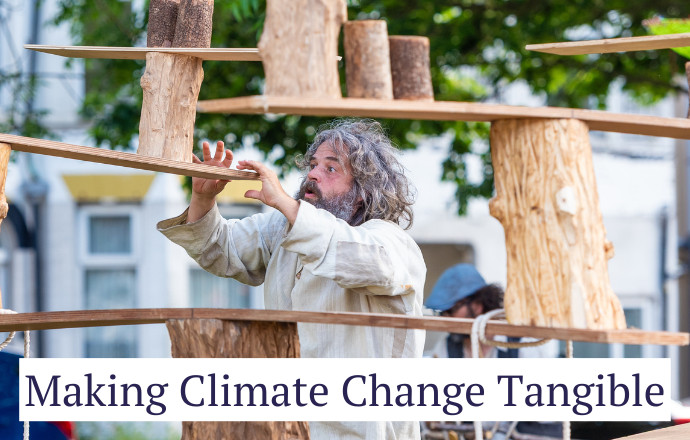
Image credit: Domte by Nacho Flores at Out There Festival 2026, produced by Out There Arts (OAUK Member), photo: James Bass Photography