Last year, for the first time, we used the DATE Toolkit (Donut Assessment Tool for Events) to give us a picture of accessibility and sustainability at our national conference. This year, we’re hoping to build on the experience and improve our offering. This Case Study serves as a chance for us to reflect on last years conference, understand how we might improve for our next conference, and what we can start considering, longer term, for future editions of the conference.
First off then, let’s have a look at last year’s DATE toolkit results.
Last Year’s Results
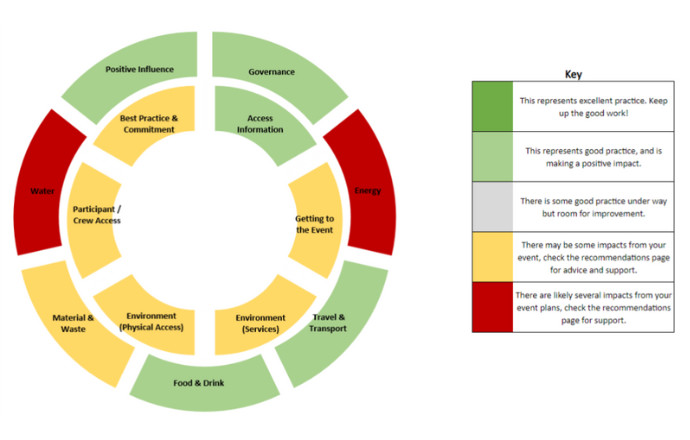
We had 5 areas where we displayed good practice, 6 areas that we should consider reviewing and 2 areas where we’d been advised to make changes.
These areas in red came down to the following:
- We didn’t have a set water conservation or monitoring plan in place for Conference 2025. Where we hire the venue for our conference, we’re currently reliant on them having a system for monitoring water use and in Stoke, we weren’t made aware of one.
- We didn’t have an energy consumption measuring or reduction plan. Again, same as the above, we’re reliant on the venue to share this information with us. We also weren’t told what type of energy tariff the venue ran on in Stoke.
This year, to respond to these areas, we’re starting our conversations with the venue earlier to understand what they already have in place from a sustainability perspective.
Now, let’s have a look at our toolkit results for conference 2026.
This Year’s Results
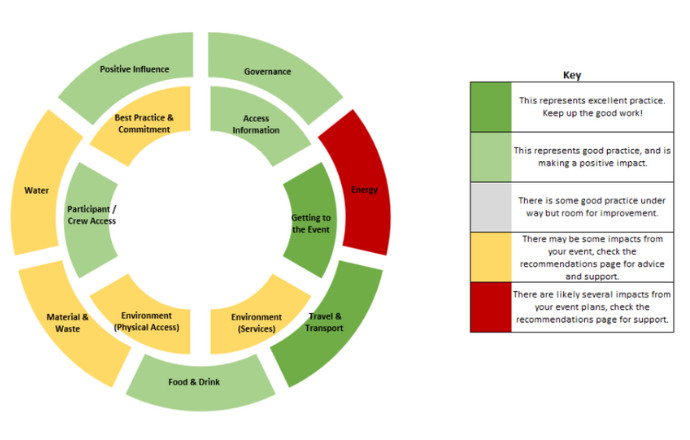
How We’ve Improved
Inner Ring
- We’ve gone from ‘maybe some impact’ to ‘excellent practice’ on getting to the event by adding a dedicated place at the event to find out access information.
- We’ve also improved on our participant and crew access by undertaking consultation with our disabled audiences.
Outer Ring
- We’ve improved on our water segment because, having visited the venue, we know where the reusable water points are,
- We’ve improved on travel and transport because of our commitment to work with local suppliers.
Areas to Improve
We’re down to one red area which means we’re taking steps in the right direction. As outlined above, this is always going to be a tricky area for us. However, with better discussions with our venue, we can understand whether it is possible to measure energy usage during the conference. Once we’ve got this base line data, in future years, we can work on whether it will be possible to reduce energy consumption. This should hopefully put us on track to improving the one area of red on our toolkit.
Our ‘consider reviewing’ areas, those in yellow, that could be improved are as follows:
Inner Ring
- Best Practice and Commitment – to improve on our best practice and commitment, our access plans need to be informed by lived experience.
- Environmental (Physical Access) – to improve on Environmental (Physical Access) we’d have to provide level access through the ‘backstage’ areas of the conference. This is a tricky one because we intentionally keep all the level access parts of the conference for the delegates and often use any parts of the venue that are inaccessible for ourselves. We also need to work on a site crew access plan to improve on this area.
- Environmental (Services) – to improve on Environmental (Services) we need to design our signage for an accessible audience and understand if the bars and traders at the conference have been briefed on accessible practice.
Outer Ring
- Water – To improve on water, we’d need a water conservation/saving plan and a plan to record and report on our water use
- Materials & Waste – to improve on our materials and waste we’d need a plan to reduce waste and increase recycling at our event and we’d need to understand if the venue separates food waste for composting.
Actions List
Using the above, we can start to create a list of actions that we need to work on in the coming months to improve our DATE toolkit results before the conference. From the above, we know we can action:
- Having our access plans informed by lived experience
- Creating a Site Crew Access Plan
- Designing our signage for an accessible audience
- Working with the venue to understand if the bars and traders have been briefed on accessible practice
- Understand if the venue separates food waste for composting
- Understanding if the venue can track energy consumption at the conference
- Clarify what energy tariff the venue are on
- Our longer-term actions, items from the above that we might not be able to introduce in the build-up to this conference are:
- Finding venues with level access throughout the ‘backstage’ areas
- Creating a water conservation/saving plan
- If we’re able to get accurate energy consumption information from the conference, we can use this to create a baseline for energy consumption and plan to reduce the impact in future
- How we can work with venues to improve their ability to recycle more and reduce waste
Mid-Project Update – with further venue information
Having completed the toolkit early in our planning process. We were able to contact Cambridge Council about our queries that are listed in the actions list above. These were:
- Working with the venue to understand if the bars and traders have been briefed on accessible practice
- Understand if the venue separates food waste for composting
- Understanding if the venue can track energy consumption at the conference
- Clarify what energy tariff the venue are on
On these items, Cambridge Council have said:
- All their staff are briefed on accessible practice
- They don’t separate food waste for composting
- They don’t, as of yet, have a way to track energy consumption but they are looking to implement, and it might be done in time for the conference
- They have clarified that Cambridge Council venues are run off entirely green renewable energy that, also, doesn’t include biomass.
- This has allowed us to change answers to two of the questions in the toolkit, these are:
Where applicable, will bars & traders be briefed on accessible practice? This goes from N/A to yes. - What will be the main power source for your event? This goes from Mains – Standard Tariff to Mains Green Tariff
Let’s see what this does to our results…
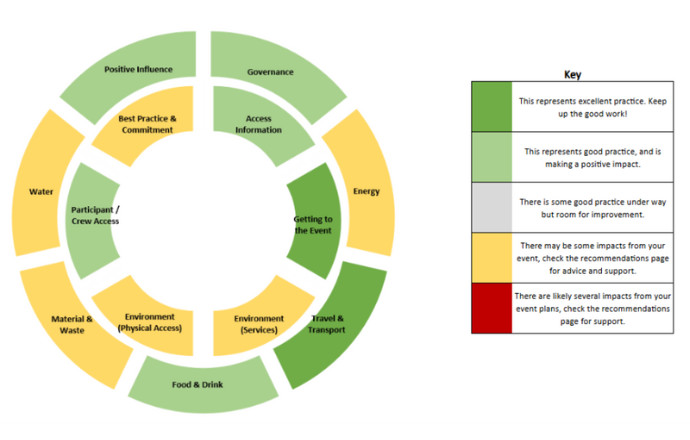
As you can see, we’ve now, because of the information we’ve learned about energy supply, upgraded our ‘Energy’ segment from ‘Advisory’ to ‘consider review’.
Because of this conversation, we can update our actions list too:
- Having our access plans informed by lived experience
- Creating a Site Crew Access Plan
- Designing our signage for an accessible audience
- Finding a way to separate food waste for composting at the event
We can now begin to work on these actions and see how they might update our toolkit results.
National Conference 2026
Browse the resources from the National Conference 2026: Change On Our Streets, including write-ups, videos, photos and more!
At the conference we also launched the sector strategy Wherever You Are, Whoever You Are, the Arts Are Yours: A Strategy for Joy and Belonging for the Outdoor Arts Sector.