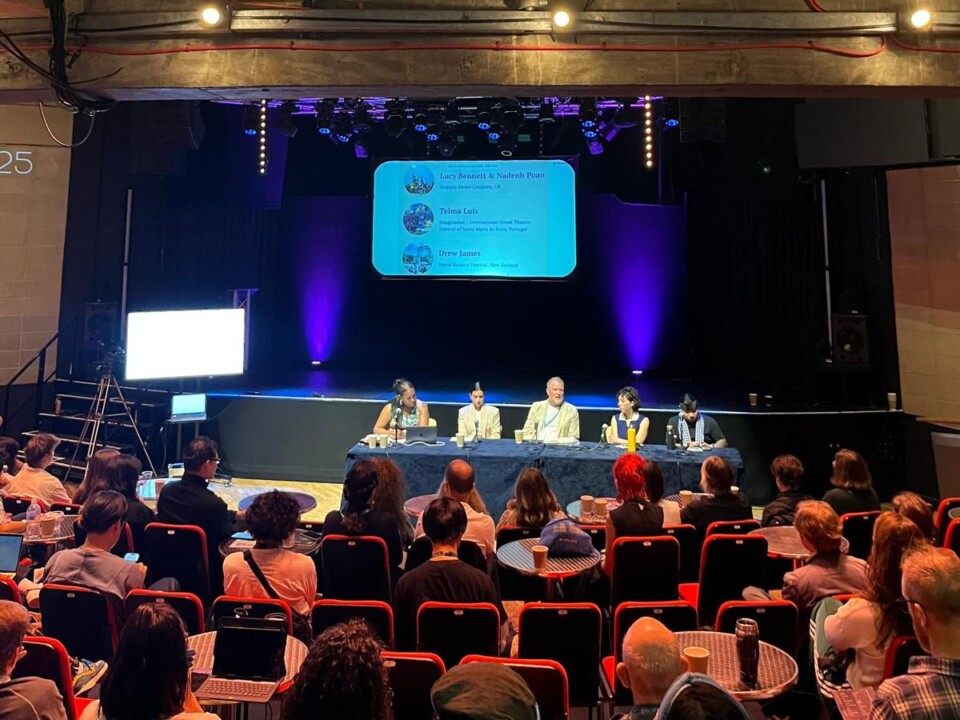
At Stockton International Riverside Festival (SIRF) 2025, OutdoorArtsUK co-organised a panel on International Collaboration with XTRAX. The session was chaired by our Associate Director Samantha Nurse as part of her assignment for leadership development. The panel discussion uncovered the enduring value of cross-border exchange but also the challenges of sustaining it in an era of funding cuts, political upheaval, and environmental urgency.
Below is a summary of the range of subjects that were discussed.
International Perspectives
- Telma Luís (Imaginarius Festival, Portugal) described how residencies, mentorship, and initiatives such as Green Streets of Europe are re-shaping creation processes with a focus on sustainability, slow travel, and deeper community engagement.
- Drew James (World Buskers Festival, New Zealand) reflected on the festival’s role in rebuilding Christchurch after the 2011 earthquake. He emphasised integrating Māori and Pacific communities into leadership and programming, while acknowledging the barriers posed by geographic isolation and the environmental cost of long-haul touring.
- Lucy Bennett and Nadenh Poan (Stopgap Dance Company, UK) showcased how inclusive practice is central to their work, employing disabled, Deaf, and neurodivergent artists in full-time roles. They noted the tension between equitable access standards in the UK and sometimes more limited provision abroad, stressing that inclusion in public space is itself a political act.
Barriers and Realities
The discussion underscored some common obstacles too:
- The precarious nature of funding and how short-term support can often undermine long-term planning.
- Accessibility gaps: awareness of equitable needs such as ramps for performers are still unmet in some places.
- Logistical and environmental limits: freight, travel costs, and carbon impact weigh heavily on international touring.
- Political pressures: shrinking rights to public space and censorship in some countries pose risks to free expression.
Impact of Collaboration
Despite these barriers, the panel illustrated the transformative power of international work.
- Stopgap’s collaboration in an EU-funded project as an Associate Partner was led by a university, which enabled their work to influence disability rights debates at cultural policy level.
- Community engagement at the Buskers Festival has built pride and intercultural exchange.
- Imaginarius residencies have opened heritage spaces to local participants for the first time, shifting institutional mindsets.
Looking Forward
The panelists called for resilient, values-driven partnerships, flexible models that prioritise cultural awareness, equitable practice, and environmental responsibility. New approaches, like online exchanges, hybrid residencies, and slow-travel collaborations. Seeing these not only as compromises but as potential drivers of innovation.
The panel discussion reaffirmed that international collaboration remains vital for outdoor arts. Despite the ongoing global challenges, it can foster inclusion, shape policy, and strengthen communities through intercultural connection. The sector’s task is now to adapt its methods without abandoning its ambitions: building a future where exchange is sustainable, equitable, and transformative.

Join OAUK
Join OAUK to become part of the Outdoor Arts community – with discounts, regular news updates, access to friendly support and resources, opportunities to develop skills and invitations to contribute to sector advocacy.